
A special guest is writing today’s PalladiumPaul blog. It’s Kurt Loft, who writes our listening notes in our Palladium Chamber Series programs. Kurt is a long-time classical music writer in the Tampa Bay area and a former colleague from my newspaper days.
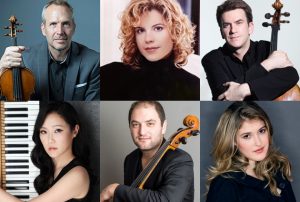
For the Jan. 14 concert, Palladium Chamber Players Jeffrey Multer and Edward Arron are joined by guest artists Jesse Mills, Milena Pajaro-van de Stadt, Phillip Ying, and David Ying for Brahms’ lush String Sextet No. 2 with Tchaikovsky’s passionate Souvenir de Florence.
Here is Kurt’s preview:
Palladium Chamber Players honor the sextet in concert
By Kurt Loft
Editor, Chamber Series Program Notes
What to do when your dinner guests unexpectedly bring along a couple of friends? Well, you set the table for six and enjoy the harmony of a larger meal.
This sums up the latest Palladium Chamber Players concert, which expands from its usual duo, trio and quartet to the larger sextet − a significant genre that achieves near-orchestral textures by doubling violins, violas and cellos.

Although Luigi Boccherini was the first important composer to write string sextets, it was Johannes Brahms nearly a century later who brought the form to prominence with his two masterworks, including the G major, Op. 36, which the players tee up Wednesday night.
Stretching about 40 minutes, the Sextet No. 2 is symphonic in length, but the material is so well wrought it seems shorter. If any work by Brahms can be described as luscious, this is it. All four movements ride on exquisitely constructed harmonies, a compressed if restrained energy and the composer’s customary penchant for dark coloring.
The opening allegro is a sweetly intense dialog among violins and violas with the cellos interjecting new themes from below deck. A five-note “Agatha’’ theme appears and repeats three times − reference to a woman Brahms loved but never married. The scherzo offers mysterious contrast, while the third movement introduces a set of five variations in which the melody is continually transformed. The work ends with a bit of fugal tinkering against a pair of spacious melodies before a rousing coda.
The second half of the program features Pyotr Ilych Tchaikovsky’sString Sextet in D minor, Op. 70, known as the Souvenir de Florence. This marvel of musical architecture, color and dramatic tension is a welcome addition to an otherwise meager genre. Tchaikovsky composed it for the St. Petersburg Chamber Music Society (of Russia, not Florida), where he held honorary membership. Completed in less than three weeks, the four-movement work wears two hats: one in its original chamber garb and the other as an arrangement for string orchestra.
Aside from its urgent opening, the music is sweetly lyrical, rich in color, and urged forward by insistent rhythms. The sextet has an almost operatic quality in its singing solos and duets, as well as the harmony of the entire group. The lovely main theme of the slow movement, which anchors the work, came to Tchaikovsky on a visit to Italy, hence the “souvenir’’ he brought back from Florence. Kurt is a journalist and arts writer who has covered classical music for the Tampa Tribune and other publications for 45 years. In addition to program notes for the Palladium Chamber Players, he contributes similar narratives to The Florida Orchestra, Opera Tampa, Bach Festival of Winter Park, and Seattle Symphony. He is a member of the Music Critics Association of North America.





Leave a Reply