TICKETS
Reserved: $45, $28, $15 – INDIVIDUAL TICKETS ON SALE TUESDAY, SEPT. 9
- Student/educator Rush: $10 cash only; starting 1 hour prior to showtime, based on availability.
- Subscription packages available for full 5-concert or 4-concert series. Call the Box Office at (727) 822-3590 to secure your seats.
Doors at 6:30pm | Show at 7:30pm
Presented by The Palladium at St. Petersburg College
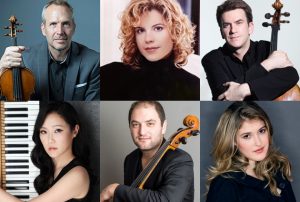
Romantic Titans – Palladium Chamber Players Jeffrey Multer and Edward Arron are joined by guest artists Jesse Mills, Milena Pajaro-van de Stadt, Phillip Ying, and David Ying for an evening of sweeping beauty, pairing Brahms’ lush String Sextet No. 2 with Tchaikovsky’s passionate Souvenir de Florence.
Jesse Mills, violin
Jeffrey Multer, violin
Milena Pajaro-van de Stadt, viola
Phillip Ying, viola
Edward Arron, cello
David Ying, cello
Program:
Johannes Brahms – String Sextet No. 2 in G Major, Op. 36
–Intermission–
Pyotr Tchaikovsky – String Sextet in d minor, Op. 70, Souvenir de Florence
Program Notes
By Kurt Loft, freelance writer and former music critic for The Tampa Tribune
Johannes Brahms (1833-1897) | String Sextet No. 2 in G Major, Op. 36
What to listen for: Brahms achieves a near-orchestral texture by doubling three instruments, with two cellos adding weight to the whole.
Contrary to what some believe, Brahms is anything but old fashioned. Arnold Schoenberg, the arbiter of modernism, advised his students to study the music of Brahms for its “varied, entwined lines’’ and thematic variations, which make their home in the richly expressive String Sextet. This unusual combination of instruments includes pairs of violins, violas and cellos, with the last two creating textural depth.
Stretching about 40 minutes, the Sextet is symphonic in length, but the material is so well wrought it seems shorter. If any work by Brahms can be described as luscious, this is it. All four movements ride on exquisitely constructed harmonies, a compressed if restrained energy and the composer’s customary penchant for dark coloring.
The opening allegro is a sweetly intense dialog among violins and violas with the cellos interjecting new themes from below deck. A five-note “Agatha’’ theme appears and repeats three times − reference to a woman Brahms loved but never married. The scherzo offers mysterious contrast, while the third movement introduces a set of five variations in which the melody is continually transformed. The work ends with a bit of fugal tinkering against a pair of spacious melodies before a rousing coda.
Pyotr Ilych Tchaikovsky (1840-1893) | String Sextet in D minor, Op. 70, Souvenir de Florence
What to listen for: The main theme of the slow movement is the “souvenir’’ Tchaikovsky brought back from his visit to Italy.
“Surcharged emotionalism” is how the New York Times once pinned down Tchaikovsky, a “weeping machine” who spun melody as easily as others breathe air. The most popular of Russian composers, Tchaikovsky’s last three symphonies, Nutcracker and Swan Lake ballets, concertos, Romeo and Juliet fantasy overture and 1812 have been box office hits for more than a century. He ranks second only to Beethoven on the programs of American orchestras. Play him, and people will come.
Like many of his orchestral works, his lone String Sextet is a marvel of musical architecture, color and dramatic tension – and a welcome addition to this meager genre. Tchaikovsky composed it for the St. Petersburg Chamber Music Society (of Russia, not Florida), where he held honorary membership. Completed in less than three weeks, the four-movement work wears two hats: one in its original form for pairs of violins, violas and cellos, and the other as an arrangement for string orchestra.
Aside from its urgent opening, the music is sweetly lyrical, rich in color, and urged forward by insistent rhythms. The sextet has an almost operatic quality in its singing solos and duets, as well as the harmony of the entire group. The lovely main theme of the slow movement, which anchors the work, came to Tchaikovsky on a visit to Italy, hence the “souvenir’’ he brought back from Florence.
About Kurt Loft, Program Notes Writer
Kurt is a journalist and arts writer who has covered classical music for the Tampa Tribune and other publications for 45 years. In addition to program notes for the Palladium Chamber Players, he contributes similar narratives to The Florida Orchestra, Opera Tampa, Bach Festival of Winter Park, and Seattle Symphony. He is a member of the Music Critics Association of North America.
The 2025-26 Palladium Chamber Series is presented with season support from Westminster Communities of Florida, with additional support provided by the St. Petersburg College Foundation, the City of St. Petersburg, and WEDU PBS.