TICKETS
Reserved: $45, $28, $15
Student/educator Rush: $10 cash only; starting 1 hour prior to showtime, based on availability.
Doors at 6:30pm | Show at 7:30pm
Presented by The Palladium at St. Petersburg College
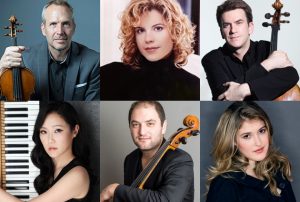
Season Finale – Palladium Chamber Players Jeffrey Multer and Marika Bournaki are joined by The Florida Orchestra’s Principal Cellist, Yoni Draiblate for a thrilling close to the 2025–26 Chamber Series, featuring Schubert’s lyricism, Shostakovich’s intensity, and Mendelssohn’s brilliance.
Jeffrey Multer, violin
Yoni Draiblate, cello
Marika Bournaki, piano
Program:
Franz Schubert – Sonatina for Violin and Piano in D Major, Op. 137, No. 1
Dmitri Shostakovich – Cello Sonata in d minor, Op. 40
–Intermission—
Felix Mendelssohn – Piano Trio No. 1 in d minor, Op. 49
Program Notes
By Kurt Loft, freelance writer and former music critic for The Tampa Tribune
What to listen for: The charm and innocence of the music harks back to early Mozart, rather than looking ahead to Beethoven. To say Schubert could write a tune is an understatement. He spun music like silk on a loom, organically melodic, melancholy and introspective. Some works, like his Unfinished Symphony, are so profound they seem to have been forged in a great furnace deep within the earth. His poetic sensibility is a rarity in music history. Some of Schubert’s more reflective pieces are the last three piano sonatas, technical challenges for even the best performers. But he also wrote simple, easy-to-play music for the amateur, such as his diminutive Sonatinas for Violin and Piano, Op. 137, published posthumously and aimed − profitably − at the home parlor player. The first of the three opens with the marriage of two themes both lyrical and moody, developed in traditional sonata form (intro, development, recap). The middle movement has been called a miniature marvel of harmonic richness that marks so much of Schubert’s chamber works, with the piano leading the way. The finale, in a rondo form that repeats the main theme, reveals a rustic, lustrous sound that is hard to imagine coming from only two instruments. What to listen for: The third movement slows almost to a halt, where notes and silence become equals. In 1934 Shostakovich began a romantic affair with his translator, and the liaison forced the composer and his wife, Nina, to temporarily separate. Increasingly burdened by the “socialist realism’’ of Josef Stalin’s censorship of Soviet arts and abolishment of organized groups, Shostakovich became deeply despondent and plunged into what would become one of his most intimate creations, the Cello Sonata in D Minor. Shostakovich cast the work in a neo-classical rather than modern style, which like so many of his works made it more difficult for the censors to accuse him of violating Stalin’s dictum. It unfolds in a traditional mix: sonata-allegro, minuet, largo and allegro. But this is structural detail; the musical effect is more adventurous − somber, edgy and impassioned. The sonata opens with a lyrical but introspective theme followed by a cascade of shifting patterns between the two instruments. A lively rhythm propels the second movement through the darkness of a sorrowful cantilena. The deeply moving and tonally unstable largo in B minor forms the heart of the work, the cello in solemn repose against the keyboard’s expansive harmonies – mirroring the feel of the composer’s Eighth String Quartet. Shostakovich tilts both instruments forward in the finale as they engage in high-spirited dialog before a terse close. What to listen for: Note the virtuosic play of the piano throughout, making this sound like a miniature concerto. The colossal works of music − Verdi’s Requiem, Mahler’s Second Symphony, Wagner’s Parsifal – command attention because they resonate with so much force. Chamber music, on the other hand, takes us on an intimate, inward journey and whispers rather than shouts. With one player to a part, nobody can hide: Every note is exposed, every error obvious, every tune personal enough to embrace. Such is the beauty and challenge of the trio form. How so few instruments can express so much with so little is, of course, the wonder of the genre. The piano’s seven-octave range is an orchestra in itself; the violin spins arias with its soprano voice; and the cello’s earthy richness anchors the team. Mendelssohn left us two exquisitely crafted trios, both in minor keys. They boil with a fiery emotion, abundance of melody and union of three voices that place them among his finest creations. He completed them in 1839 and 1845, respectively, nearly a half century after Haydn had mastered the form, and he was fully aware of two other definitive works by Beethoven, the Ghost and Archduke. The first trio is full of nervous energy, faithful to the tempo markings agitato and appassionato in the opening and closing movements. It begins with the cello’s voice and an outpouring of melody that immediately envelops the listener, the music cast in a concertante style – as if the pianist is trying to pull off a concerto. The second movement is literally a song without words, with a variation in the minor key. In the scherzo, Mendelssohn shows his delicate, elfin side, full of grace and sparkle and a transparency of sound that requires a skilled ensemble to pull off. The finale revolves around a rhythmic pattern borrowed from poetry − one stressed syllable against two without accents − followed by a cello aria that leads to a rousing conclusion by the group. Kurt is a journalist and arts writer who has covered classical music for the Tampa Tribune and other publications for 45 years. In addition to program notes for the Palladium Chamber Players, he contributes similar narratives to The Florida Orchestra, Opera Tampa, Bach Festival of Winter Park, and Seattle Symphony. He is a member of the Music Critics Association of North America.
Franz Schubert (1797-1828) | Sonatina for Violin and Piano in D Major, Op. 137, No. 1
Dmitri Shostakovich (1906-1975) | Cello Sonata in D minor, Op. 40
Felix Mendelssohn (1809-1847) | Piano Trio No. 1 in D minor, Op. 49
About Kurt Loft, Program Notes Writer
The 2025-26 Palladium Chamber Series is presented with season support from Westminster Communities of Florida, with additional support provided by the St. Petersburg College Foundation, the City of St. Petersburg, and WEDU PBS.