TICKETS
Reserved: $45, $28, $15 – INDIVIDUAL TICKETS ON SALE TUESDAY, SEPT. 9
- Student/educator Rush: $10 cash only; starting 1 hour prior to showtime, based on availability.
- Subscription packages available for full 5-concert or 4-concert series. Call the Box Office at (727) 822-3590 to secure your seats.
Doors at 6:30pm | Show at 7:30pm
Presented by The Palladium at St. Petersburg College
Echoes in E-Flat – The Original Chamber Players bring Mozart’s grace, Strauss’ charm, and Schumann’s brilliance to life in an evening of refined chamber music.
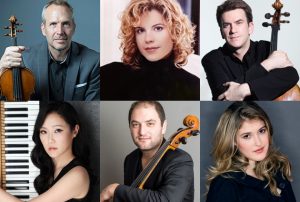
Jeffrey Multer, violin
Danielle Farina, viola
Edward Arron, cello
Jeewon Park, piano
Program:
Wolfgang Amadeus Mozart – Piano Quartet No. 2 in E-flat Major, K. 493
Richard Strauss – Ständchen in G Major
Richard Strauss – Festmarch in D Major
–Intermission–
Robert Schumann – Piano Quartet in E-flat Major, Op. 47
Program Notes
By Kurt Loft, freelance writer and former music critic for The Tampa Tribune
Wolfgang Amadeus Mozart (1756-1791) | Piano Quartet No. 2 in E-flat Major, K. 493
What to listen for: The final movement includes what the Mozart scholar Alfred Einstein called “the purest, most childlike melody ever sung.’’
Mozart’s genius is the stuff of legend and needs little reinforcement 235 years after his death. In his short life he gave us 626 published creations, and at least a hundred rank as supreme masterpieces in Western art. Within that group, a prized handful seem to have been forged by a higher power.
“As an artist, as a musician, Mozart was not a man of this world,’’ writes Alfred Einstein in his seminal 1945 biography on the composer. “Mozart’s music, which to so many of his contemporaries seems to have the brittleness of clay, has long since been transformed into gold, gleaming in the light, though it takes on a different luster for each new generation.’’
If Mozart’s operas contain his most intimate music, his best chamber works are equally humane, including the Piano Quartet No. 2 – one of the earliest combinations for piano and string trio. But he didn’t treat it as a newcomer; the writing, especially for the keyboard in the opening movement, is pure and exacting, bright in color and fresh in invention. Mozart had earlier completed his operatic masterpiece, Marriage of Figaro, and listeners can feel its influence in the aria-like conversations among violin, viola and cello.
Mozart reserved one of his purist melodies for the larghetto, going back and forth between violin and piano like a series of echoes, followed by a profusion of good tunes so masterfully synchronized in the closing rondo. Listening to this music with eyes closed, it almost sounds like a chamber-sized piano concerto.
Richard Strauss (1864-1949) | Ständchen in G Major and Festmarch in D Major
What to listen for: These two works show the introverted and extroverted sides of Strauss.
Strauss's Ständchen and Festmarch are early chamber works arranged for larger forces, composed between 1875 and 1893. Ständchen (Serenade) is a charming and intimate piece, while Festmarsch (Festival March) is a more lively and celebratory work. These pieces, along with Arabischer Tanz and Liebesliedchen, were likely composed for family occasions rather than public performance.
The music for the serenade, a “song for the evening,’’ was inspired by the poetry of Adolf Friedrich von Schack, who founded a famous art gallery in Munich. Here, Strauss creates a dreamy atmosphere, suggesting lovers sharing an intimate moment. The rippling sound of the piano over a floating vocal line evokes the moonlight of a dark night. After a whirl of contrasting phrases, the music reaches a climax based on the poetic line Flush red, flush red, with the rapture born of the night. In tonight’s performance, the violin replaces the sometimes-used soprano voice.
With Festmarch, Op. 1 (not to be confused with Johann Strauss Jr.'s Fest-Marsch, Op. 452), the composer turns extroverted, as if writing for a large outdoor concert or military band. Essentially an anthem in style, the march reflects confidence in its structure and development, which Strauss would perfect in his later large-scale works. Often performed as a brassy affair with timpani, winds and strings, this more restrained version chosen by the Palladium group is an arrangement for piano quartet, where each voice stands firmly on its own ground.
Robert Schumann (1810-1856) | Piano Quartet in E-flat Major, Op. 47
What to listen for: Taking a tip from Beethoven, Schumann upends tradition by switching the positions of the slow movement and scherzo.
As we look at Schumann’s career, his compositions appear as chapters, following his habit of writing in one medium at a time: chamber music one year, symphonies the next, and entire seasons devoted to songs or church music. In 1842 alone, after extensive study of Haydn and Mozart, he wrote three string quartets, the Piano Quintet, the Phantasiestucke, and the Piano Quartet you will hear tonight. After this burst of creative energy, Schumann would never again continue at such a pace; mental illness ruled the remaining 14 years of his life.
The Quartet mirrors the Quintet in sharing the same key and shows influences of both Schubert’s Trio No. 2 and Beethoven’s String Quartet, Op. 127 − also in E-flat major. The piano drives the action throughout, and the expansive game plan feels almost theatrical in size and scope, stretching nearly half an hour. Schumann tips his hat to Beethoven by switching the traditional lineup of movements, with the high-spirited scherzo coming before the slow movement.
From start to finish, Schumann expresses his ideas with both romantic sweep and intimacy, and surprises us with a canon for piano and strings in the opening section. Most touching is the third movement, marked andante cantabile, a delicate conversation among the four instruments that sets the stage for an exuberant fugue in the closing vivace. Note the prominence of the cello through all this; Schumann dedicated the Quartet to an amateur cellist and patron, and no doubt wanted to make an impression.
About Kurt Loft, Program Notes Writer
Kurt is a journalist and arts writer who has covered classical music for the Tampa Tribune and other publications for 45 years. In addition to program notes for the Palladium Chamber Players, he contributes similar narratives to The Florida Orchestra, Opera Tampa, Bach Festival of Winter Park, and Seattle Symphony. He is a member of the Music Critics Association of North America.
The 2025-26 Palladium Chamber Series is presented with season support from Westminster Communities of Florida, with additional support provided by the St. Petersburg College Foundation, the City of St. Petersburg, and WEDU PBS.