TICKETS
Reserved: $45, $28, $15
Student/educator Rush: $10 cash only; starting 1 hour prior to showtime, based on availability.
Doors at 6:30pm | Show at 7:30pm
Presented by The Palladium at St. Petersburg College
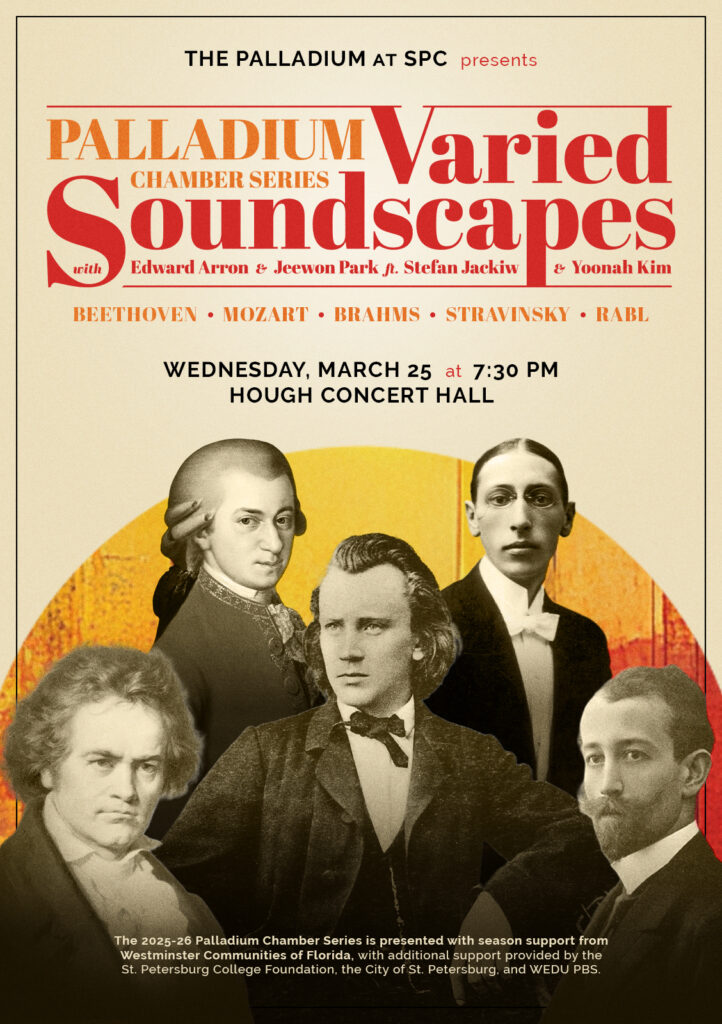
Varied Soundscapes – Sensational guest artists Stefan Jackiw and Yoonah Kim perform alongside Palladium Chamber Players in a bold, colorful program of works for winds and strings, spanning Beethoven to Stravinsky.
Yoonah Kim, clarinet
Stefan Jackiw, violin
Edward Arron, cello
Jeewon Park, piano
Program:
Ludwig van Beethoven – Variations in E-flat Major for Piano, Violin and Cello, Op. 44
Wolfgang Amadeus Mozart – Rondeau from Duo in G Major for Violin and Viola, K. 423
Johannes Brahms – Trio in a minor for Piano, Clarinet and Cello, Op. 114
—–Intermission–
Igor Stravinsky – Suite from L’Histoire du soldat for Clarinet, Violin and Piano
Walter Rabl – Quartet in E-flat Major for Piano, Clarinet, Violin and Cello, Op. 1
Program Notes
By Kurt Loft, freelance writer and former music critic for The Tampa Tribune
Ludwig van Beethoven (1770-1827) | Variations in E-flat Major for Piano, Violin and Cello, Op. 44
What to listen for: Beethoven takes an isolated tune and builds it into a multi-layered partnership for three instruments.
George Bernard Shaw once said that Beethoven could create good music from a pile of sticks. This was no understatement, as the 14 variations you are about to hear evolve from little more than a twig of a theme.
The opus number assigned suggests the composer entering his middle period, but Beethoven wrote the piece at age 22 − a decade before its publication − when he was still finding his musical voice. He borrowed the tune from the spoken-language opera The Red Cap by Carl Ditters von Dittersdorf, which premiered in Vienna in 1788 and has been all but forgotten.
Beethoven already knew how to tease the listener: the variations begin simply, almost like a nursery song, only to grow in three-part complexity. The players open on a mechanical beat, as if following a metronome, the staccato melody waiting for its harmony to arrive.
Soon, the first variation appears in flowing legato, followed by a third, then a fourth as the music grows in texture and intensity − reaching a high point in the 10th. By the end, we realize how Beethoven has engaged us in a varied narrative, of improvisational twists and turns that would hint at later masterpieces such as the Diabelli Variations.
Wolfgang Amadeus Mozart (1756-1791) | Rondeau from Duo in G Major (originally) for Violin and Viola, K. 423
What to listen for: Even a replacement instrument honors the elegance of Mozart’s original creation.
Tonight’s performance of the last movement of the Duo in G features a clarinet replacing the viola in an arrangement by Yoonah Kim. The switcheroo was done for practical reasons: Kim and her husband – the violinist Stefan Jackiw, who also appears in this program – were in COVID lockdown in their New York apartment and wanted to play more pieces for their chosen instruments.
“All of our concerts were canceled, and like so many musicians, we suddenly found ourselves isolated,’’ she said. “We were stuck in our apartments and unable to make music with others. So, I began arranging duets for clarinet and violin so we could play together in our living room.’’
The tinkering presented its share of challenges. Where the viola can play double stops, a clarinet only plays single notes, so Kim gave careful thought to which note of each chord would preserve the harmony. She also had to adjust the octave placement, either raising or lowering lines to better suit the clarinet's range and to explore new sonorities between the instruments.
But the music, she said, speaks for itself, and the new version more than complements the original. The rondeau’s lively tempo, delicate counterpoint, and interplay of recurring themes make it a favorite among chamber musicians.
“I was drawn to the elegance and wit of the musical dialogue between the two voices,’’ she said. “I believe that the clarinet, with its vocal warmth and wide dynamic range, brings a fresh lyricism that enhances this conversational quality in a different way.’’
Johannes Brahms (1833-1897) | Trio in A Minor for Piano, Clarinet and Cello, Op. 114
What to listen for: Brahms masterfully exploits the clarinet’s low, middle and high ranges with an intimate feel for shades and colorings.
The clarinet holds a special place in the late career of Brahms, who essentially came out of retirement to deliver four woodwind masterpieces: two sonatas, a quintet, and the trio on this program. Encouraged by the clarinet virtuoso Richard Mühlfeld, Brahms devoted himself to expanding the instrument’s repertoire by taking it, for the first time in any of his works, outside its orchestral home.
His retirement may have stayed on track had Brahms not heard Mühlfeld play the Mozart Clarinet Quintet. Awestruck, he befriended the musician and spent hours listening to him play, which had a reawakening effect, notes Jan Swafford in his 1997 centennial biography on the composer.
“Now he experienced an epiphany of an instrument in itself,’’ he writes. “In Mühlfeld hands and breath, the clarinet was capable of endless nuances of color and volume. Here was a musician who could make the instrument sing like a violist or a mezzo-soprano.’’
In the Trio, Brahms explores so well what Swafford describes as the rich reediness of the low register, the gentle paleness of the throat tones and the piercing cry of the high register. Cast in four movements, the Trio maintains a dark and serious tone throughout, broken only by the cheerfulness of the andante.
In the terse opening allegro, the piano’s aggressive underpinnings support the liquid lines of its counterpart; the cantilena melodies of the adagio are among Brahms’ most exquisite; the andantino takes on the character of a waltz; and the closing movement blends two themes that both compete and complement each other as they scamper toward an animated finish.
Igor Stravinsky (1882-1971) | Suite from L’Histoire du soldat for Clarinet, Violin and Piano
(Texts arranged by Yoonah Kim)
What to listen for: A hodgepodge of styles, the score includes a Lutheran chorale, a tango, a march, a waltz, and a bit of klezmer and ragtime.
Stravinsky composed The Soldier’s Tale under hard times. The revolution in Russia had cut him off from steady income, his younger brother Gury died of typhoid fever, and the Spanish flu pandemic created turmoil on a global scale.
Undaunted, Stravinsky decided to write something relatively easy to produce on stage for a small rank of musicians and performers, at the same time generating much-needed cash. The result was this musical pocket play about a soldier who sells his violin to the Devil in exchange for wealth. Since its premiere in 1918, the piece has appeared in different guises, such as the minimalist suite – reduced from 16 to 5 sections − you will hear tonight in an arrangement by Yoonah Kim. Instead of separate speaker parts, Kim gives these roles to the musicians.
“My goal with added narration was simply to make this iconic piece feel more accessible for both performers and audiences,’’ Kim said. “The music is incredibly vivid on its own, but since the suite is just a few excerpts from the larger work, I felt it could benefit from a bit of narration to help carry the story along.’’
The sections include:
- The Soldier’s March
- The Soldier’s Violin
- The Little Concert
- Three Dance: Tango, Waltz, Rag
- The Devil’s Dance
“I included short excerpts from the original text as spoken narration, and placed them in between musical movements,’’ Kim added. “I tried my best for it to be woven into the performance like a storyteller guiding the audience. Because the text is read by the musicians, it demands a little bit of theater from the players.’’
Walter Rabl (1873-1940) | Quartet in E-flat Major for Piano, Clarinet, Violin, and Cello, Op. 1
What to listen for: : Note how Rabl makes use of a variety of styles, including a funeral march, fugue and Austrian song.
Most people have never heard of Walter Rabl, an Austrian conductor and composer whose significant works can be counted on the fingers of one hand. Rabl had hopes of being a lawyer, then decided to write music in a short-lived career known almost exclusively for the work on tonight’s program.
Rabl entered the score in a 1896 competition held by the Vienna Musicians Association, where Johannes Brahms − terminally ill with pancreatic and liver cancer − sat on the panel. The quartet won first prize and it seemed Rabl was a new golden boy in European music, but he produced few other works before his full-time commitment as a choir master.
Historically, the E-flat Major Quartet is among the few 19th-century work scored for this combination of instruments, with the clarinet replacing the customary viola. Cast in four movements and very much in the vein of Brahms (not surprisingly), the opening movement is warm and expressive, and Rabl manages to create a feeling of free form within traditional sonata structures.
The second movement is the most unusual, as it begins as a funeral march and evolves into a fugue. A short third movement unfolds like a Viennese song and the finale moves along an expansive harmonic blueprint before ending with seven resounding chords on the piano.
About Kurt Loft, Program Notes Writer
Kurt is a journalist and arts writer who has covered classical music for the Tampa Tribune and other publications for 45 years. In addition to program notes for the Palladium Chamber Players, he contributes similar narratives to The Florida Orchestra, Opera Tampa, Bach Festival of Winter Park, and Seattle Symphony. He is a member of the Music Critics Association of North America.
The 2025-26 Palladium Chamber Series is presented with season support from Westminster Communities of Florida, with additional support provided by the St. Petersburg College Foundation, the City of St. Petersburg, and WEDU PBS.